

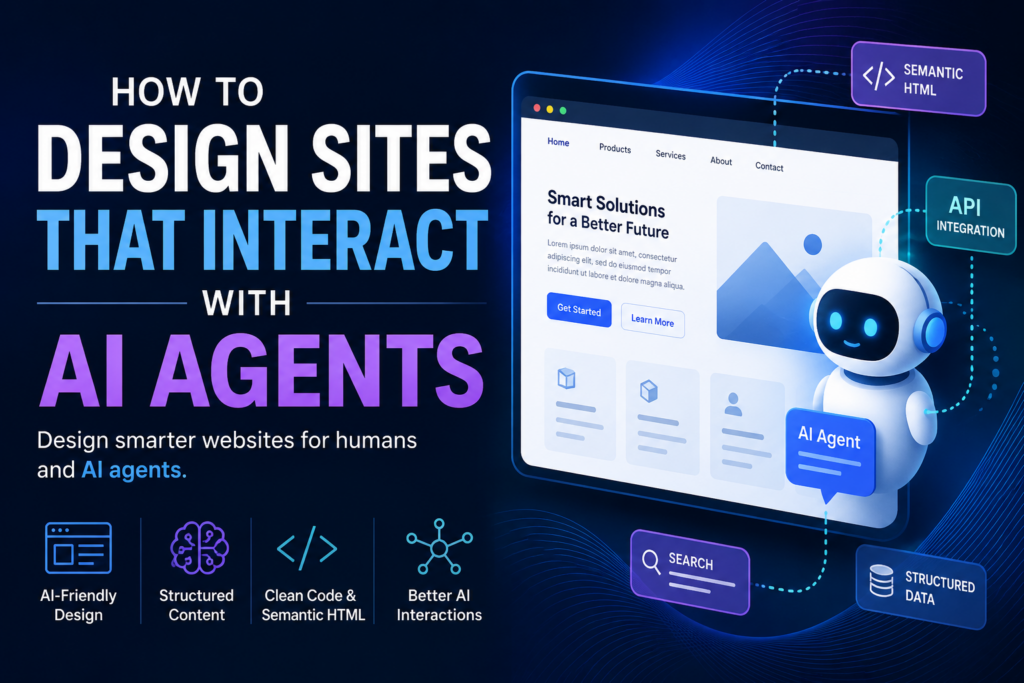
The way websites are used is changing. For years we built sites for human visitors—people who open pages, scroll, click buttons, and fill forms. Now a new approach is emerging: agentic AI design, which treats AI agents as first‑class users.
AI agents — smart tools that browse sites, collect information, answer questions, compare products, and even perform actions are becoming part of how people interact with the web. That means designers and developers need to think differently.
Agentic AI Design
The question is no longer only “How do we design websites for people?” It’s also “How do we design websites that AI agents can understand and interact with properly?” This is becoming a key topic for the future of web development.
What are AI agents?
AI agents are software systems that perform tasks automatically using artificial intelligence. Examples include:
- Assistants that answer questions by reading web pages
- Tools that browse sites for information or compare products
- Bots that book appointments or complete transactions
- Search systems that collect and summarize content
Instead of humans doing everything manually, agents can interact with websites and complete tasks much faster. That changes how sites should be structured.
Why traditional websites can struggle
Many sites are built for visual impact. They focus on:
- Animations and complex layouts
- Hidden menus and interactive micro‑UI
- Heavy client-side JavaScript
Those features may look great to people, but they can make life harder for agents. Problems include:
- Important content loading too late to be read
- Confusing or unclear navigation
- Poorly structured information that’s hard to extract
- Buttons and controls that don’t explain their purpose
AI systems work best when sites are predictable, well-structured, and clearly labeled.
Get a professionally designed and developed website tailored to your needs.
As an experienced website developer based in Delhi NCR, I offer customized solutions to build responsive, SEO-friendly, and user-friendly websites. Whether it’s for a personal blog, business site, or e-commerce store, I ensure your online presence stands out.
The web is moving toward machine-readable experiences
We’re seeing a shift from purely visual design to designs that are also machine-friendly. Developers are focusing more on:
- Structured data and semantic HTML
- Public APIs and data downloads (CSV/JSON)
- Accessibility and clear content hierarchy
Many accessibility and SEO best practices help agents too — so a lot of this work benefits both humans and machines.
Agentic AI Design Structure matters more than fancy design
A common mistake is prioritizing visual flair over clarity. A beautiful site can still be confusing to an agent. For agent-friendly design, structure matters more than sparkle. That means:
- Proper headings and meaningful page titles
- Organized navigation and clean HTML structure
- Descriptive buttons and form labels
Small changes make a big difference. For example, “View pricing plans” is far better than “Click here” for people and for agents.
Agents need context
Humans can often infer meaning from layout or visual cues. Agents need explicit context. If labels are vague or sections are poorly organized, an AI agent may not know what action to take next. That’s why descriptive content is more important than ever — explain things clearly instead of assuming users will figure it out.
APIs are becoming more important
Agents will increasingly use APIs instead of scraping pages. APIs let systems fetch booking availability, inventory, pricing, and product data directly. Websites that provide useful, secure APIs will work much better with these tools.
AI-Friendly Websites Need Better Content Organization
Agents process information differently than people. They analyze headings, extract key facts, and identify relationships between sections. To help them:
- Use clear headings and short paragraphs
- Keep a logical content flow and avoid clutter
- Organize information into distinct sections (summary, specs, FAQ)
These practices also improve the experience for human visitors.
Voice Search and AI Agents Are Connected
Voice assistants and conversational AI amplify the need for clear answers. When a user asks a voice assistant a question, the agent must quickly find a concise, relevant answer. Pages that use natural language and directly answer common questions perform better in these contexts.
Accessibility Is No Longer Optional
Accessibility features — proper labels, alt text, semantic HTML, and keyboard navigation — help both people and machines understand your content. Agentic AI Designing with accessibility in mind doubles as preparing for AI interaction.
How the developer role is changing
Developers used to focus on building interfaces and features. Now they also need to think about:
- Machine-readable structure and schema
- Secure API surfaces for agent interactions
- Automation and intelligent workflows
- Conversational interfaces and integrations
Future Agentic AI Design websites: what I expect
Websites will become more dynamic and collaborative with AI systems. For example:
- Agents might auto-fill forms or request confirmations
- Sites could adapt responses based on agent requests
- Assistants may communicate directly with web apps to complete tasks
- Search systems may summarize and combine information automatically
That means sites must support both human visitors and AI-driven interactions.
Also Read: Claude AI Surge Sparks Fear: Is AI Replacing Web Developers in 2026?
Practical steps to get started
- Use semantic headings and meaningful titles.
- Add short factual summaries near the top of important pages.
- Provide JSON-LD, Schema markup, and downloadable CSV/JSON for tables and charts.
- Offer transcripts and metadata for audio/video.
- Publish clear APIs or a discovery endpoint for agent access.
- Include author, date, and source information so agents can judge reliability.
- Implement rate limits and authentication for sensitive or private data.
- Give users and agents a feedback path to report errors.
Common pitfalls to avoid
- Making machine markup an afterthought. Treat machine-facing data with the same editorial care as visible content.
- Exposing private data via public endpoints. Keep user-specific information behind proper auth.
- Relying on fragile scraping. Provide canonical, machine-readable sources instead.
- Omitting provenance. Agents need dates and sources to assess trust.
A simple example
On a product page:
- Keep storytelling and marketing copy for people.
- Add an “agent brief” that lists SKU, price, availability, and a short factual summary.
- Provide an /api/product/sku-123 endpoint returning canonical JSON.
- Offer a CSV download of full specs and a transcript for any product video.
This lets an agent answer price or availability questions accurately while people still enjoy the marketing content.
Final thought
The web is entering a new phase known as Agentic AI Design. Designing for AI agents doesn’t replace human-focused design — it complements it.
Start by making your highest‑value pages machine‑readable:
add clear structure, simple summaries, structured data, and a few well-documented APIs. Do that, and your site will be more discoverable, more useful, and better positioned as agents become central to how people find answers and complete tasks.
Developers who understand this shift early will likely have a strong advantage in the future.


