

You’ve probably used an AI assistant like Claude or ChatGPT and asked it to do something — book a meeting, check your orders, create a task. But have you ever wondered how the AI actually connects to those systems to get things done?
That’s where APIs and MCP come in. And right now, one of them is clearly winning for AI work.
Let’s understand MCP vs API.
What is a REST API?
Think of a REST API like a waiter in a restaurant.
- You are the customer who wants food
- The waiter takes your order to the kitchen
- The kitchen prepares it and the waiter brings it back
In software, your app is the customer, the API is the waiter, and the database is the kitchen.
This works perfectly when you know exactly what to order. A human developer reads the documentation, writes code, and places the request correctly every single time.
The problem? AI agents are not human developers. They do not read documentation in advance. They figure out what they need step by step, in real time. And REST APIs were never built for that.
Why REST APIs struggle with AI agents
Here are the four real problems REST creates when AI tries to use it:
Problem 1: No memory between requests
Every REST API call starts completely fresh. The server processes your request and immediately forgets you exist. For a human developer, that is fine because the code manages context manually. For an AI agent handling a five-step task, that is a serious problem. The agent has to carry all the context itself, which burns tokens and slows everything down.
Problem 2: The AI has to know endpoints in advance
With REST, you need to know exactly which URL to call before making a request. There is no built-in way for the AI to ask “what can you actually do?” and get a structured answer back. A human reads the docs first. An AI agent working in real time cannot afford that step.
Problem 3: Every tool needs its own custom integration
Want to connect your AI to five different tools? You write five different custom integrations. Each one has its own auth system, its own error handling, its own response format. Two integrations mean two connections to maintain. Five integrations mean up to twenty custom pieces of code. That stack grows fast and breaks often.
Problem 4: It was not designed for AI thinking
REST APIs return data. They do not explain what the data means, what the AI should do with it, or when a particular tool makes sense to call. The AI guesses. And guessing leads to wrong endpoints, incorrect parameters, and misunderstood responses. That is where hallucinations in API integrations come from.
What is MCP?
MCP stands for Model Context Protocol. Anthropic introduced it in November 2024 as an open standard that lets AI agents connect to tools, data, and systems in a way they can actually understand.
Here is the simplest way to picture it:
An MCP server sits between your AI and your tools. It tells the AI exactly what it can do, how each tool works, what inputs it needs, and what it will return back. The AI reads all of that at runtime and decides what to use, without any human writing integration code first.
No guessing. No hardcoded endpoints. No custom wrapper per service.
Why AI agents prefer MCP?
1. Self-discovery
With a REST API, an AI agent has to go through this process before doing anything useful:
Agent → Read Documentation
Agent → Understand Each Endpoint
Agent → Write Custom Integration Logic
Agent → Hope It Got Everything Right
With MCP, that entire process collapses into three steps:
Agent → Connect to MCP Server
Agent → Discover Available Tools Automatically
Agent → Use the Right Tool
No custom integration required. The agent figures it out on its own.
2. Standard tool format every agent understands
Every MCP server exposes capabilities in the same predictable structure:
- Tools — actions the agent can perform
- Resources — data the agent can read
- Prompts — reusable templates for consistent behavior
An AI agent that knows MCP can connect to any MCP server and immediately understand what is available. It does not need to learn each system from scratch. Think of it like every tool now speaking the same language.
3. Fewer hallucinations and fewer failures
This is one of the biggest practical wins for developers.
Traditional API integrations often cause agents to call wrong endpoints, send incorrect parameters, and misunderstand what a response actually means. The agent is essentially guessing based on incomplete information.
MCP explicitly tells the model upfront:
- Which tools are available right now
- Exactly what parameters each tool requires
- What the expected output looks like
The result is measurably better accuracy and far fewer failed calls in production.
4. Dynamic tool discovery
Here is a concrete example that makes this click: MCP vs API
Traditional API approach:
The agent must already know that Stripe has a “Create Customer” endpoint before it can use it. If that endpoint changes or a new one gets added, someone has to update the integration manually.
MCP approach:
The agent connects to the MCP server and asks what tools exist right now. The server responds with the current list. The agent discovers “Create Customer” automatically and uses it, no prior knowledge needed.
This is what makes autonomous AI agents actually practical in real-world systems. The agent adapts to what is available instead of depending on what was hardcoded six months ago.
5. Better context sharing across your whole system
Traditional REST APIs are stateless by design. Every request starts fresh with zero memory of anything that happened before.
MCP allows agents to access a unified interface across:
- Files and documents
- Databases and records
- Business data and internal reports
- Knowledge bases and company documentation
All through one consistent connection. For enterprise AI agents handling complex multi-step tasks, this is not a nice-to-have. It is the difference between an agent that works and one that constantly loses the thread.
Does MCP replace REST APIs? No. Here is what actually happens
A very common misconception is that MCP will make REST APIs obsolete. The reality is the opposite. MCP runs on top of APIs, not instead of them.
Here is the actual architecture: MCP vs API
AI Agent
    ↓
MCP Server  ← intelligent layer lives here
    ↓
REST API
    ↓
Your Application / Database
The REST API still exists and still does its job. MCP acts as an intelligent layer between AI agents and your existing APIs. Your backend does not change. A new entry point gets added on top.
A real-world example: with and without MCP
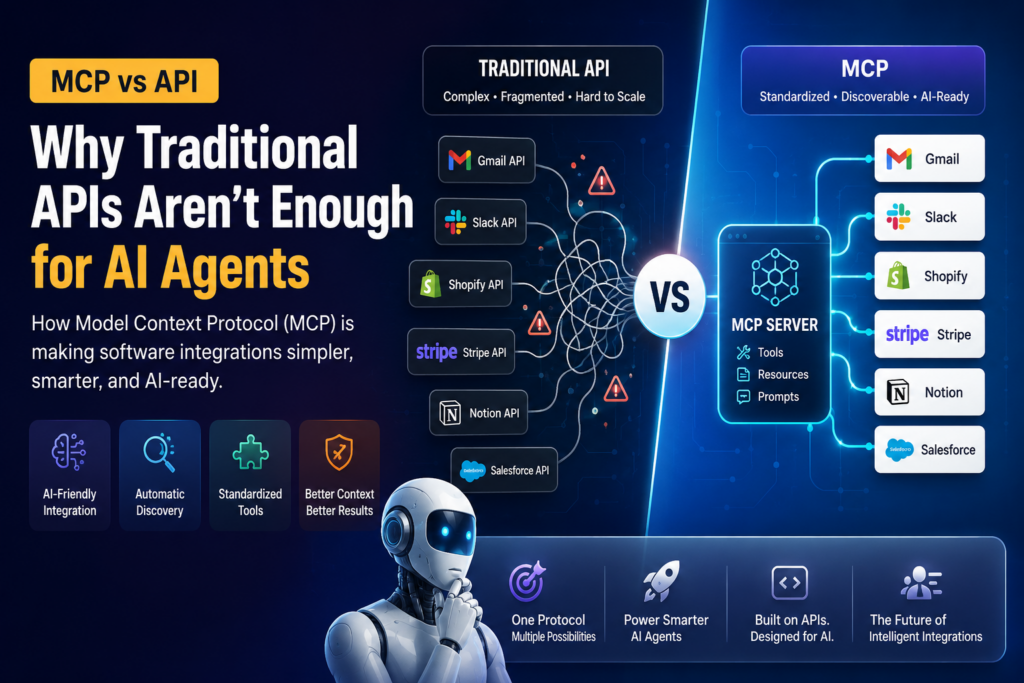
Say you want your AI to handle customer support across five tools — Shopify, Gmail, Slack, Notion, and HubSpot.
Without MCP:
AI Agent
 ├── Custom Shopify Integration
 ├── Custom Gmail Integration
 ├── Custom Slack Integration
 ├── Custom Notion Integration
 └── Custom HubSpot Integration
Five separate integrations. Five different auth systems. Five different error patterns to debug. Every time one API changes, something breaks.
With MCP:
AI Agent
    ↓
One MCP Layer
    ↓
Shopify  |  Gmail  |  Slack  |  Notion  |  HubSpot
One standard protocol handles everything. The agent connects once and discovers all five tools automatically. When an API changes, only the MCP server gets updated, not every integration downstream.
The numbers that prove MCP is not just a trend
- React took 3 years to hit 100 million monthly downloads on npm
- MCP hit the same milestone in just 16 months
- By March 2026, the MCP SDK crossed 97 million monthly downloads
- Over 5,800 community-built MCP servers exist today
- OpenAI shut down its own competing standard and switched to MCP
- Microsoft, Google, AWS, and Cloudflare all signed on as supporting members
When competing tech giants agree on one standard at that speed, the direction of the industry is settled.
Are you in need of a skilled WordPress developer to bring your website vision to life?
Look no further! Whether you need custom themes, plugin development, site optimization, or ongoing support, I offer expert WordPress development services to suit your needs.
For PHP and Laravel developers specifically
Laravel has an official MCP package. You can expose your existing Eloquent models, service classes, and business logic to any AI client without rebuilding a single thing.
Your REST API keeps serving web and mobile clients exactly as it does today. Your MCP server sits alongside it as the AI entry point. Same codebase. Same database. Same business logic. Nothing gets thrown away. A new surface gets added.
MCP servers are becoming the new API gateway for AI agents, and every Laravel developer who builds one now is ahead of the teams scrambling to catch up in 12 months.
Also Read: How to Build an MCP Server with PHP & Laravel
MCP vs API
| Feature | Traditional API | MCP |
|---|---|---|
| Built For | Developers | AI Agents |
| Discovery | Manual | Automatic |
| Documentation | Human-readable | Machine-readable |
| Tool Understanding | Hard | Native |
| Integration | Custom coding | Standardized |
| Agent Friendly | Low | High |
| Context Sharing | Limited | Built-in |
| Tool Discovery | No | Yes |
The one-line summary
MCP vs API: APIs connect applications to applications. MCP connects AI agents to applications.
They solve different problems for different consumers. The developers who understand that difference now will build faster, more reliable AI integrations than everyone else playing catch-up later.


